

How to customize the style
If you want deeper style customization capabilities, check out our Custom CSS article. You will need a developer for this.
How to embed
Planpoint can be embedded into any kind of website, from custom HTML/CSS/JS to platforms like Webflow, SquareSpace, Wix or WordPress. A Planpoint embed code is simply a few lines of HTML and JavaScript.
A Responsive Inline Channel will horizontally fill the width of its parent element and grow vertically based on the content of the channel.

Video Guide on how to embed
Step-by-step guide
1
Step 1
To access the Style & Embed module, locate the project you wish to access in your Planpoint dashboard and click on the Style & Embed button.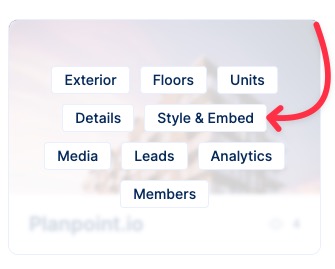
2
Step 2 - Embed & Hosting
In the Embed & Hosting card, you’ll find:
- Project path - the part of the URL that identifies this project (what used to be called the “namespace”). Changing it breaks any embed code already pasted on your site.
- Language - the language your embedded Viewer displays in. To support multiple languages on your site, generate and paste a separate embed code for each one.
- Custom Domain (optional) - serve your Viewer (and crawlable per-unit pages, for SEO) on your own subdomain instead of planpoint.io.
- Embed Code - click Click to copy to grab the current HTML/JS snippet for the language selected above.
- Planpoint URL - opens the live Viewer in a new tab, handy for testing before you paste the code anywhere.
Theme and color changes are no longer baked into the embed code - the Viewer always pulls your latest style live, so you never need to re-copy/re-paste the code after a style change. Only the Project path and Language affect the code itself.
3
Step 3
Test your plan viewer with Planpoint URL and make changes accordingly - reload the tab after each change to see it take effect.
4
Step 4 - Style
Further down, the Style card lets you fine-tune how the Viewer looks and behaves:
Click Customize Style to pick a theme, set a custom color scheme (see the color guide), and edit your project’s terminology.